Questão 62006
UEA 2018
(UEA - 2018)
Leia o texto para responder à questão.
Plastic-eating bacteria discovered by student could help solve global pollution crisis
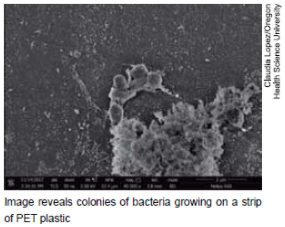
A student may have found a solution to one of the world’s most urgent environmental crises – breeding bacteria capable of “eating” plastic and potentially breaking it down into harmless by-products. The microbes degrade polyethylene terephthalate (PET) – one of the world’s most common plastics, used in clothing, drinks bottles and food packaging. It takes centuries to break down, in the meantime doing untold damage to its surroundings.
Morgan Vague, who is studying biology at Reed College in Oregon, said the process could play a “big part” of solutions to the planet’s plastic problem, which sees millions of tonnes dumped in landfill and oceans every year. Around 300 million tonnes of plastic is discarded each year, and only about 10 per cent of it is recycled.
She began hunting for microbes adapted to degrade plastic in the soil and water around refineries in her hometown of Houston. Taking her samples back to college in Portland, Oregon, Ms Vague began testing around 300 strains of bacteria for lipase, a fat-digesting enzyme potentially capable of breaking down plastic and making it palatable for the bacteria. She identified 20 strains of bacteria that produced lipase, and of those, three that boasted high levels of the enzyme. Next, she put the three microbes, one of which appears to have been previously undiscovered, on a forced diet of PET she cut from strips of water bottles. She was stunned to find the bacteria worked to digest the plastic.
(Tom Embury-Dennis. www.independent.co.uk, 30.06.2018. Adaptado.)
No trecho do terceiro parágrafo “She was stunned to find the bacteria worked to digest the plastic”, o termo sublinhado tem sentido equivalente, em português, a
espantada.
decepcionada.
apavorada.
despreocupada.
indecisa.
Gabarito:
espantada.
Resolução:
a) CORRETA, dado que o termo "stunned" significa algo como "espantada", indicando que a pesquisadora não esperava ver o que viu na sua pesquisa.
b) INCORRETA, uma vez que a pesquisadora não ficou decepcionada, pelo contrário, ela descobriu uma coisa que pode ser muito útil para a humanidade.
c) INCORRETA, pois a pesquisadora não ficou apavorada com sua descoberta, já que não lhe causou medo, apenas espanto.
d) INCORRETA, visto que não temos um termo aqui que remete à preocupação ou à despreocupação, não se trata de uma descoberta ruim.
e) INCORRETA, considerando que não é uma descoberta passível de escolha.